
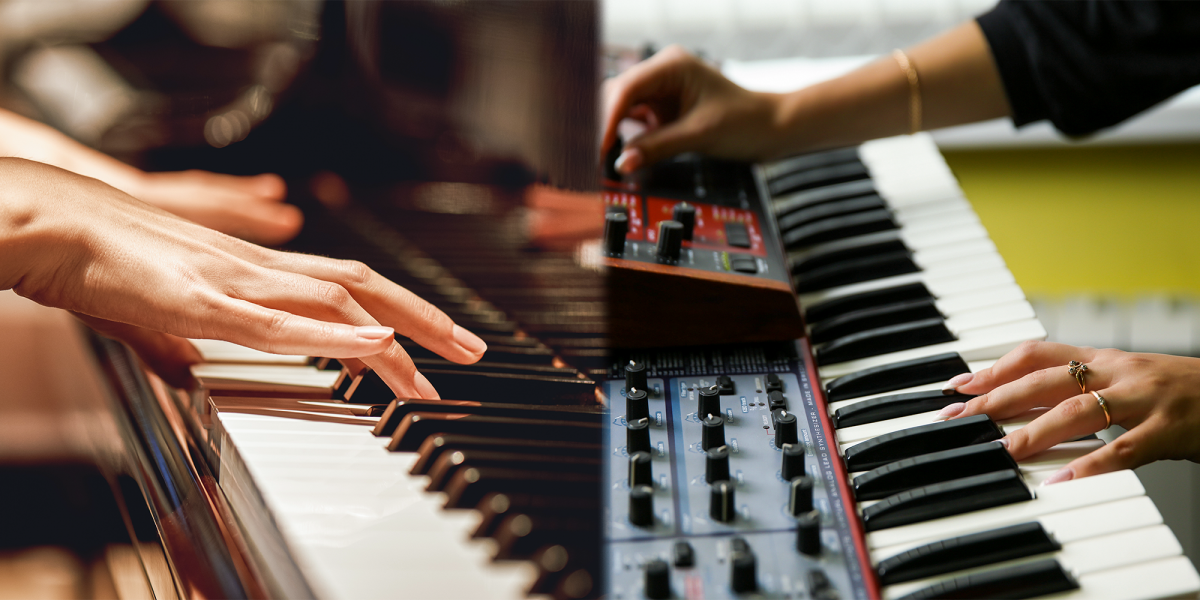
Short answer: effective piano practice is not a single neuroscience “hack.” The strongest practical pattern is a feedback loop: choose one observable problem, attempt it, inspect what happened, change one variable, and test it again. Research with pianists also supports using physical practice as the foundation, adding mental rehearsal selectively, and treating sleep, spacing, recording, and practice variety as tools rather than guarantees.
This guide separates direct piano evidence from broader motor-learning evidence. That matters because a finger-tapping experiment is not the same as learning voicing, pedaling, memory, and interpretation in a complete piece.
What does “effective” piano practice mean?
A productive session should change something you can hear, feel, or measure. “Practice the first page” is an activity. “Play measures 9–12 three times at 60 bpm with the left-hand rhythm correct” is a testable goal.
In a study of 22 pianists learning assigned Bach works, Aaron Williamon and Elizabeth Valentine found that total practice quantity was not significantly related to the final performance ratings. Some features of how the pianists organized practice were related to better ratings, but this small study does not prove that hours are irrelevant. It shows why a practice log needs more than minutes.
| Practice tool | What the cited research tested | Reasonable piano use | Do not conclude |
|---|---|---|---|
| Structured practice | Recorded practice and judged performances from 22 pianists | Track the task, criterion, and result—not only time | Practice duration never matters |
| Mental rehearsal | A challenging unfamiliar sequence with 16 expert pianists | Rehearse sound and movement between physical attempts | Imagery replaces playing |
| Practice variety | Interval leaps in 36 music students and tempo variation in 48 novices | Add nearby variations after a stable version exists | Random practice is always superior |
| Sleep | A laboratory finger-sequence task, not a piano piece | Retest a passage the next day before adding repetitions | Sleep automatically improves the passage |
| Recording | Brief playback interventions with 25 advanced piano students | Use short recordings to compare one named feature | Listening once guarantees objective improvement |
1. Turn repetition into a feedback loop
Repeating a passage can be useful, but only if each repetition answers a question. Start by naming one target: correct notes, pulse, fingering, balance, articulation, pedaling, or continuity. Then choose a criterion that can pass or fail.
- Attempt: play a small unit once without stopping.
- Diagnose: identify the first specific mismatch, not a general verdict such as “bad.”
- Change: alter one condition—tempo, hands, rhythm, fingering, dynamic layer, or starting point.
- Retest: return to the original task and check whether the change transfers.
This prevents an easier exercise from becoming the entire session. For example, hands-separate work is valuable only if it eventually improves the hands-together passage. A metronome can supply a stable timing reference, but a rising tempo number is not proof that notes, balance, and movement remain controlled.
2. Make the practice unit small enough to diagnose
A whole-page run contains too many variables to explain a failure. Reduce the unit to one transition, one beat, one fingering change, or one voicing problem. Keep enough musical context to preserve the movement into and out of the spot.
A useful unit often includes the note before the problem and the note after it. If the error returns only when the preceding phrase is restored, the difficulty may be the approach—not the visible “hard chord.” Change starting points as soon as a fragment becomes reliable so that memory does not depend on one launch point.
3. Use slow practice as a diagnostic condition
Slow practice is not automatically careful practice. Its value is that it creates time to observe fingering, release, alignment, and sound. Choose a tempo at which the target action is possible without emergency corrections. If the movement at that tempo is unrelated to the intended performance gesture, the tempo may be too slow for the question being tested.
After two or three accurate attempts, test a modestly faster tempo or a longer unit. If coordination collapses, return to the last successful condition and change only one demand. The fuller slow-practice guide explains how to avoid turning reduced tempo into disconnected note-by-note motion.
4. Treat mental practice as a supplement
In a study of 16 expert pianists, mental practice improved performance of an unfamiliar, motorically challenging sequence, but physical practice produced greater improvement. The researchers also found different associations for motor imagery and auditory imagery. That is narrower—and more useful—than the claim that simply visualizing activates “the same brain regions” and replaces keyboard work.
Try a short mental pass after a physical attempt:
- look at the score and hear the next two measures internally;
- name the harmony, fingering, or landing points;
- imagine the timing and distance of the movement without tensing the hands;
- play once and compare the result with the imagined version.
If the sound or movement cannot be imagined clearly, return to a smaller unit. For memory work, combine mental landmarks with the retrieval checks in the piano memorization guide.
5. Add variety after establishing a reference
“Mix up your practice” is too broad. Two piano studies show why. In a 36-student interval-leap experiment, fixed, varied, and spaced groups had comparable errors at several tests, while transfer findings offered only partial support for variable practice. In a separate study of 48 nonmusicians, changing tempo and ordering produced different effects on timing and movement variability; more variation was not uniformly better.
Use a reference-first sequence:
- Establish one accurate version at a workable tempo.
- Change one feature: nearby tempo, different starting point, altered rhythm, or one adjacent interval.
- Return to the reference version.
- Keep the variation only if the reference improves or transfer becomes more reliable.
This is a practical experiment, not a rule that random order always wins.
6. Retest after a break instead of trusting the final repetition
The last attempt of a session benefits from immediate repetition. That performance is not the same as durable learning. Revisit the passage after another task, later in the day, or the next day before warming it up again. A cold retest reveals whether the fingering, sound plan, and starting cues can be retrieved.
Sleep research is often overstated. One controlled finger-sequence study found that sleep stabilized an early performance boost rather than creating an additional gain. Because the task was finger tapping—not expressive piano performance—the safe takeaway is modest: sleep is part of normal recovery and memory, but the passage still needs to be tested again.
7. Record one question, not every run
A 2025 study with 25 advanced piano students tested short playback interventions. Students who heard their playing reported improvements in several parameters, but external professional ratings did not show significant effects. Recording can therefore support observation without guaranteeing better performance.
Make a 20- to 40-second recording and listen for one feature only:
- Is the melody consistently above the accompaniment?
- Does the pulse change before the difficult measure?
- Are pedal changes aligned with harmony?
- Does the phrase keep its direction through the cadence?
Write one observation and make one change. Recording an entire session can create more reviewing than learning.
A research-informed 20-minute piano practice plan
| Time | Task | Evidence of success |
|---|---|---|
| 0–2 min | Cold retest of yesterday’s passage | Record the first breakdown without restarting |
| 2–8 min | One small technical or rhythmic problem | Three controlled attempts at the chosen criterion |
| 8–12 min | Restore musical context | Problem remains improved with surrounding measures |
| 12–15 min | One useful variation | Reference version survives the variation |
| 15–18 min | Short recording or uninterrupted run | One named observation, not a general score |
| 18–20 min | Mental review and next-session note | Write the starting point and first test for tomorrow |
The durations are adjustable. A sustainable piano practice routine should fit the player’s schedule, physical comfort, repertoire, and instruction—not imitate a laboratory protocol.
What should a piano practice log record?
Use five fields: passage, target, condition, result, and next test. For example: “Measures 17–20; even left-hand sixteenths; 56 bpm hands together; two of three clean but melody became flat; next session cold-test at 56 and record balance.” This note is more actionable than “practiced 20 minutes.”
Stop or change the task when pain, numbness, or persistent strain appears. Motor-learning research does not override physical safety, and this article is not medical advice. A qualified teacher can help with musical and technical diagnosis; persistent symptoms belong with an appropriate healthcare professional.
The honest conclusion
The science of effective piano practice is less dramatic than popular productivity advice. Small piano studies support careful goals, physical practice, selective imagery, feedback, and retesting. They also show mixed or limited findings for practice variety and recording. Broader motor research can suggest experiments, but it cannot promise a specific result for every pianist or piece.
The most defensible routine is simple: define the problem, choose a measurable condition, listen closely, change one variable, retest in context, and check again after time has passed. That turns practice from repeated activity into evidence-guided learning.
Research sources
- Williamon and Valentine (2000), quantity and quality of musical practice
- Ericsson, Krampe, and Tesch-Römer (1993), deliberate practice and expert performance
- Bernardi et al. (2013), mental practice in expert pianists
- Bangert, Wiedemann, and Jabusch (2014), variability of piano practice
- Carter and Grahn (2018), practice variability in a piano timing task
- Nettersheim et al. (2015), sleep and motor-sequence stabilization
- Köpp et al. (2025), audio-feedback interventions with piano students
